Friday, May 3, 2013

Nuremberg

J and I spent a whirlwind 36 hours in Nuremberg over the weekend. Despite having written (in my capacity as book review editor) a finely crafted, 120-word booknote for Kansas History on the memoir of a guard at the Nuremberg Trials, we weren't sure what to expect. One doesn't think of Nuremberg as a city -- just a courtroom -- but today it's the pleasant heart of a metro area of over 3.5 million people. As you might expect, though, the ghosts of the past roam freely here. 

Soon after arrival, and after the requisite visit to the first of several Old if Rebuilt Churches, we enjoyed a rejuvenating Thai meal. I think the food was great, but I'm not sure; I could barely taste it because I went a little overboard, due to the sheer joy of access, with the multiple house-made chili sauces (which tellingly required a special request to secure). We spent all Saturday afternoon at the German National Museum. Brent had warned us that we'd need a lot of time, but wow, that really was a lot of Roman pots. The museum has 20 million items, although I think that number is a bit inflated by counting each individual beer glass in the dollhouse collection (home of a 1639 dollhouse). 


Apparently Das Germaniches Nationalmuseum also has a bunch of important art, too, and the oldest globe in the world (Dürer's), and some big chest where they stored the jewels of the Holy Roman Empire, but I can't remember any of that stuff after seeing 3261 paintings, musical instruments, and recreated German kitchens in 139 minutes. I do remember the 1960 Luftansa serving tray, however.


We also struck the mother load in the Bruegel department. Although the Detroit Institute of Arts owns Bruegel's "The Wedding Dance," part of a trilogy of paintings that includes the even more famous "Peasant Wedding," somehow this painting appeared right in front of us in Nuremberg. I couldn't find any mention online of "The Wedding Dance" being on loan, but here's the proof.


Bruegel put us in a middlebrow mood. Every once in a while when traveling there comes a time to abandon the fruitless search for the authentic, pick up the guide book, and embrace the unabashedly touristical, in this case, the world's oldest Nuremberg sausage house. (Nuremberg sausages, similar to small American breakfast links, are among our favorite.) So off we went Zum Gulden Stern, first mentioned in 1419, and the survivor of many wars.


The sausages were indeed excellent. But here was the precise moment when I hit the wall on the absurd lack over here of a) beer variety in restaurants, a.1) craft beer culture, and b) vegetables not named potato or gemischter salat. Sprich mir nach, Deutsche: A-L-E. (Gillian, you would have died of laughter the next day, when, as the result of this apotheosis of German cuisine, I wandered the streets like a mad man looking for a Berkeley-style vegan wrap establishment. Needless to say, my search was in vain, even if happycow.net claims 12 vegetarian restaurants in the city.) The beer, a mass produced but local Tucher Pils, was the absolute worst of the trip -- so vaguely sweet and weak and flavorless that I am willing to give Zum Gulden Stern the benefit of the doubt that they gave me a Radler (beer mixed with Sprite) by mistake. Don't be fooled by Tucher's advertisement with the nice view of Nuremberg and one of the Old Churches.


And just look at this meal, a parody -- if a true-to-life example -- of carbs gone wild (and touristical bread). I should admit for the record, however, that said worst beer of the trip is the one on the left nearly entirely consumed, while J's acceptable hefeweizen is still invitingly full. Look, I figured that if I raced, then the server would ask me if I wanted another, which is a rarity around here ...


I did like the fact, though, that even in this shrine to Germania, the new Germany was well on display. The sausages were made by a team of an older woman of European descent who was likely born in Germany and a man of Asian descent who was likely an immigrant. Here's to open societies and open-grill cooking ... if not entirely open borders in the U.S.


Absolutely insistent on finding a real beer vom Fass, we then headed to Kloster Andechs "Das Wirsthaus," the satellite establishment of a monastery near Munich brewing since 1455. Now we were getting somewhere! The doppelbock was very good, if not as remarkable as suggested by its astounding scores of 97 on Beer Advocate and 99 on Rate Beer. We might have to put the actual abbey on our list after reading this blog description...


But I digress. On Sunday morning, we took the tram to the Nazi Documentation Center a few kilometers from the center of town, in the enormous but mostly uncompleted complex that the Nazis built as a massive party center. You might recall that Nuremberg was a key locale for the Nazis and the site of those eerie mass rallies well documented on film. The museum, open for barely a decade, is located in the quarter-completed Congress Hall.


The main exhibit inside, which emphasizes the rise of the Nazis from a local perspective, is well done, and got me thinking about historiographical debates I hadn't thought about since I was an undergraduate, when I wrote my senior thesis on Nazi ideology. These were the years of the height of the Histoikerstreit (historians' quarrel) about the rise of and nature of National Socialism. This debate centered on such questions as: was the Holocaust unique?; can we meaningfully compare Nazism to other forms of totalitarianism?; to what extent were the mass of German people responsible for the crimes of Nazi Germany (as Hitler's "Willing Executioners"), or can we start to think of some non-Jewish and non-gay and non-disabled Germans as Hitler's victims also?; and, was Nazism somehow the result of unique "peculiarities" of German history or was it much less inevitable? A related debate concerns whether we can and/or should "historicize" Nazi Germany, that is, consider it a "normal" (if utterly vile and criminal) part of history.

For the most part the museum did a good job of presenting mainstream historical interpretations. And it clearly concluded that the masses shared the blame. Still, my ears perked up a couple times when listening to the audio guide. At one point, when describing the Tasel on the Cult of Hitler, the recording said, "It was difficult for any individual to resist the cult of the Fuhrer." Oh really, so after a party of virulently racist thugs takes over power, usurps democracy, and employs kitschy rhetoric combining a childish take on German folk traditions and the ancient world ("restoring pageantry and colour and mysticism to the drab lives of twentieth-century Germans," as William Shirer wrote in his diary), it was difficult for thinking Germans to resist an idiotic worshiping of an idiotic man?

Walking around the complex also got me thinking about historical memory and commemoration. It's been more than a decade since I dabbled in the history and memory literature -- though I can still make Professor Mohr, my master's advisor, laugh out loud by invoking the one phrase -- "outside memory worker" -- that I (attempted to) contribute to the field in my article on the commemoration in Brookings, Oregon, of the World War II bombing outside of that town by a Japanese submarine. [Ok, try translating that last sentence into German!] So I'm out of my league here. But how are we to commemorate evil? Part of Zeppelin Field, where the largest rallies were held, still stands. One can walk out onto the same central podium that Hitler did.

The area in front (where Hitler's soldiers are marching in the first picture) is now essentially a closed street, and the day we were there, some 20-somethings were playing a game of rollerblade hockey. (The main rally grounds beyond are now soccer fields.) And every year it's also used as part of an auto racing track. So is that appropriate? What should we do with crumbling evil space? On the one hand, I wish Hitler could have seen a multi-ethnic group of friends making a mockery of his sacred space. And maybe it's good that one can rent a plastic swan boat to take on the lake. On the other hand, does using Nazi rally grounds as playgrounds and soccer fields historicize the Nazis too much, making them too much a part of the normal and very long ebb and flow of German history? Should the U.S. have destroyed the huge swastika after the war? Should we not rope off this complex and put a big sign up that reads "Serious Bad Stuff Happened Here?" There are signs commemorating the rally grounds, of course, but they normalize Nazi history a bit too much for my taste. The one near Zeppelin Field, for example, traces the history of those flying machines and explains how the field Hitler built on was a testing ground for them. And another sign, near the beer hall that has never ceased operating on the edge of the lake, shows turn-of-the-century Germans row boating and explains new middle-class leisure activities. Does such signage turn the Nazis into just another moment in time? And finally, how much money should private organizations and the state pay to maintain a rain-damaged stadium that the Nazis used? Would that money not be better devoted to aiding past and present victims of attempted genocides? Which reminds me, I was very glad that the museum pointed out that Hitler also oppressed and killed gay people.

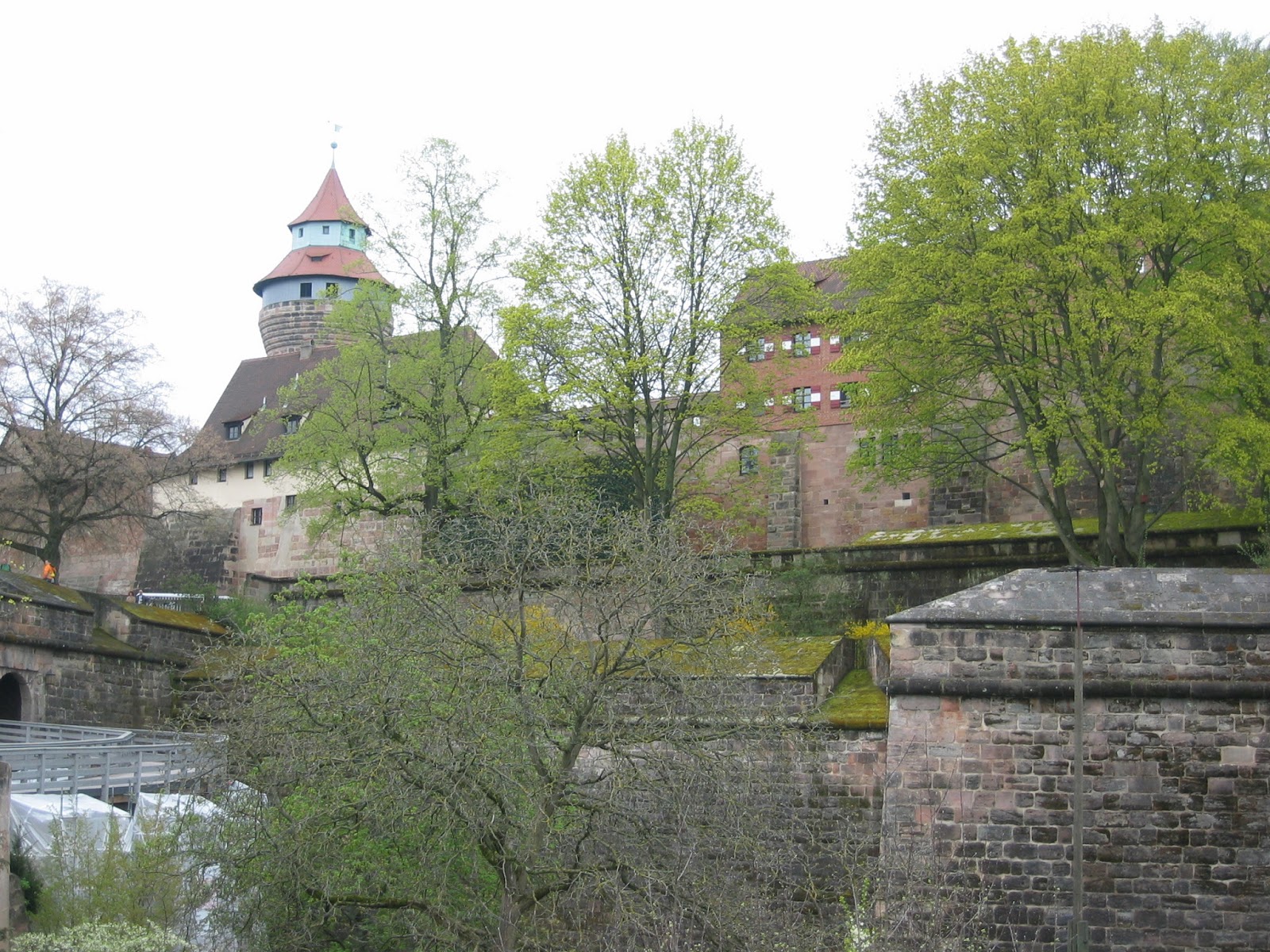
I can understand now why the Germans retreat so much into the distant past. After the Documentation Center, visiting Nuremberg's Imperial Castle was a welcome relief. About a 1,000 years old, it was an official residence of the Holy Roman Empire (and apparently most of the Emperors until the 16th century spent substantial time there). Nice view of the city, too.


From there, it was a mad dash through the usual historic square, with the famous Golden Fountain, more Old Churches, Dürer's House (why do the Germans love audio guides pretend-narrated by the wives of long-dead famous people?), and the city museum. Many of Dürer's paintings are in Washington, D.C. right now, by the way.


We thought we had entdeckened the perfect way to end the weekend: a burger at the burger-specializing place near the train station. But, unfortunately, after no one came to the table for 12 minutes, we decided it was better to catch our train -- and to put on hold our continuing search for a decent burger.

Meanwhile, it's time for me to spend more time emulating "The Scholar" in the National Museum.


Friday, April 26, 2013

Lustnau Läuft!

Before normal and reader-sucking content resumes, thanks for putting up with my self-promotional blitz last week, and for your re-posting, tweeting, etc. And just think, it could have been worse. On the same day that my op-ed appeared in the NY Times, The Page 99 Test ran my blurb describing page 99 of The State and the Stork. So you were spared a separate blog entry, etc.

On Sunday, J, Betty, Dong, and I, among several others from MPI, ran a local Hobbylauf (another great word!) in a nice area of Tübingen called Lustnau. It was a sky-less, cool day -- in other words, perfect for running. We appreciated the moment of silence for the victims of the Boston bombings. And just before that, everyone did group calisthenics together, led by the race director! Oh to have had a camera at that moment. 

Indeed, we were in culture shock all day. The differences between American and German races are nearly insurmountable. To begin with, the race was 9 Euros, t-shirt included. When was the last time you paid $12 for a race in the states? Now, it's true (as far as I can tell) that Germany lacks a charity race culture (because they actually have a state?), and so you could argue that the difference in cost disappears into taxes, but whatever: the race was cheap. And what percentage of the take at American races goes to charity in the end, anyway?

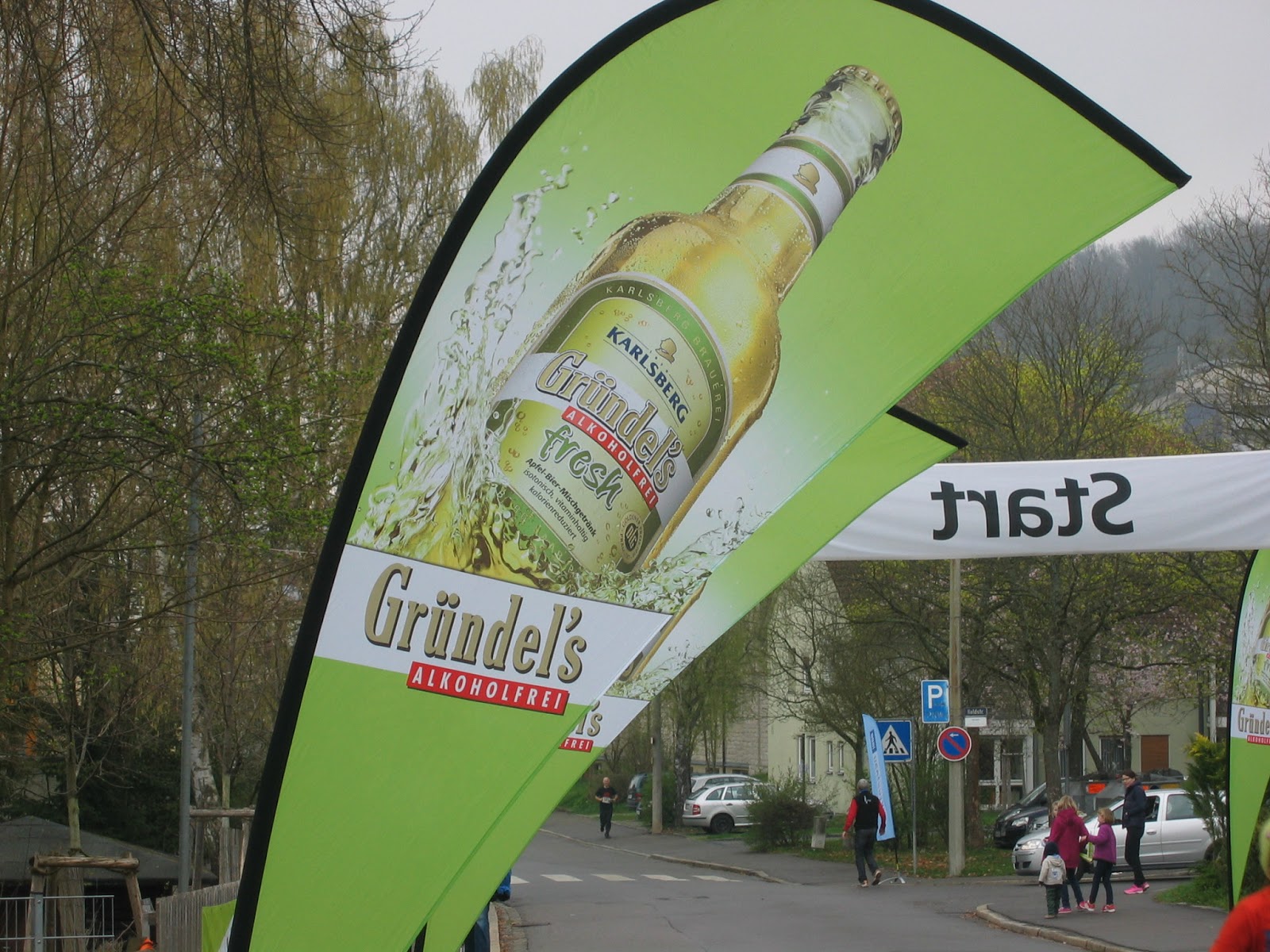
It's also true that the organizers saved money by not providing water or Gatorade after the race. No water at a restaurant is one thing, but none after a 7k/half marathon!? That's beyond the pale. They did offer a concoction called Gründel's Alkoholfrei, a nearly undrinkable apple-flavored brew. This is not a knock against alcohol-free beers overall, by the way. I'm known for liking them more than 99% of Americans, and they are widely consumed and delicious over here. I'm convinced that if an American brewery could make one almost as decent as any number of German ones, they would make a killing. But this one tasted like someone squeezed a rotten apple into a Miller 64. I can't blame the organizers, though: Gründel was obviously the main sponsor.


Beverages for sale, however, they had in abundance. One could have coffee (with cake) with porcelain cup and saucer. And, needless to say, they set up a temporary beer garden so one could have a vom Fass in a real glass. It's times like these I don't miss the states ...


Another check on the German side of the ledger: the race started at the civilized time of 1 p.m.

The run itself was a very fun one mostly through the woods, across the road from the Bebenhausen Monastery. Because my back has been acting up, I had no miles under my belt to speak off, so I aimed for a doable pace and popped Aleve liberally. And I felt pretty good considering the complete lack of training. But don't worry, this isn't going to become one of those blog entries where the blogger talks about how happy he is just to be out there, enjoying the gift of running and the fresh air, even if he'll never be as fast again, blah blah. Screw that. My goal remains a marathon p.r. next year. You can tell I was all business. No time to pose for frivolous pictures with a GPS watch to set. 


The short and long routes split just after a sharp turn, so I couldn't tell which direction the racers in front of me went as they were quite a distance ahead of me. For a moment I thought I might have a shot at a top-3 finish, but the first guy I caught up with spoke English, of course, and naturally he said, "We are in 5th, so no podium for us." What else would he have said? Then again, at least according to Google Translate, the German word for podium is Das Podium. Proves how much I learned watching ski jumping all February in German.

I came through the finish line in about 29:55 (my official time was 30:01, as I didn't realize for a moment that the guy had to scan me with his scan gun), good enough for 5th place. Not sure if I won my age group. That doesn't seem to be a big thing here. Wie sagt man "age group medal"? My guess is that I'm about 25 seconds a mile off my peak.

J had a good race, too, even if Betty had unfortunately assured us that there were no hills. (Her half admission on the way to the race: "There might be a small hill.") In fact, the first 1.2 miles were pretty much straight uphill -- more elevation gain than the entire Twin Cities marathon. Betty has run too many ultras in Utah, I think. 

Within 180 seconds after I finished, I had purchased and consumed the best burger of the trip so far -- as well as discovered how bad Gründel's Alkoholfrei is. Seems the key to enjoying burgers in Germany is to fail to get your heartrate past threshold for three months and then, as a result, to run exceptionally hard in a race. Otherwise, expect to be disappointed. I think I might just start a burger consulting company here ... definitely more money in that than in history. Let's compare the burger at High West Distillery, with caramelized onions, fried shallots, a mix of local cheeses, and a seeded brioche bun, topped with house-made pickles, to the burger at the BurgerMeister here in Tübingen, shall we?


It's times like these I miss the states ... Of course, we knew we were in trouble when BurgerMeister's sign (like its webpage) promised "Real American Food." Reminds me of signs in the Czech Republic circa 1993 ... It was also a bad omen that the TV in the place was set to a Croatian soccer channel. Do Croatian burger proprietors really think that Thousand Island dressing is what makes a burger American? Then again, the burgers have been no better anywhere else (I keep sadistically thinking I'll get lucky). To me the most outrageous thing is that we are currently living amidst the best bread on earth, and yet restaurants here nonetheless insist on serving their burgers on frozen and terrible buns (though I guess those are in fact American ...).  Kind of like living in the breadbasket of the world in Manhattan, KS, and having no bakeries.

Anyway, for your next post-race recovery meal, I highly recommend the combination of a burger, french fries (why don't our races have deep fat fryers?!) and German apple cake, washed down with a glass of surprisingly good Swabian whiskey, in this case, Bosch Alb-Dinkel from Lenningen, too small to even have an image online.

Wednesday, April 17, 2013

My New York Times Editorial

I had an op-ed in the April 17 paper edition of the New York Times (first published online April 16).

Here is the link to the article.

Many of you reading this blog helped me at some point with The State and the Stork, and/or with this op-ed, so let me take this opportunity to thank you. It takes a village to make the Times.

By the way, when we went to sleep in Germany the night before the piece came out, we had no idea that the op-ed was going to run. We awoke to frantic e-mail messages from the editor and my unfairly burdened publicist at the University of Chicago Press. So I did not see the final version before it went in, but all turned out well. Every night, J turns on our cherished iPad white noise app and checks e-mail one last time -- and J was on the e-mails, which is a long story ... -- but, amazingly, this one night we slept white noise-less for the first time since we moved to our churchbellatorium of a neighborhood.

Wednesday, April 10, 2013

The Pure Essence of Germany

After Zurich, Pat and Bill and J and I embarked on a week's expedition in search of the essential Germany -- the idyllic landscapes of castles and lederhosen-clad farmer-brewers of nineteenth-century romantic poets' dreams.

** Academic's disclaimer: Ok, in case you didn't guess by now, I'm being flippant. For the record, all cultures, ethnic identities, religions, marriage laws, and sports governing bodies are social constructions, and I can't stand it when anyone throws around the term "natural" [exception: it is in fact natural for humans to eat meat]. And it was a cult of the essential Germany that, um, helped get the country in so much trouble. Btw, if you want a hilariously irreverent but still sympathetic book that playfully skewers Germans' obsession with their distant past (often not as distant as imagined), I highly recommend Simon Winder's Germania. It's been the ideal accompaniment to our journeys.

Our quest began close to home, indeed comically close to home considering we almost managed to get lost on a 3k hike departing from the Max Planck. Getting lost in German forests is hard to do: they are extremely managed (Brent says that every tree has been mapped), and they provide a bench suitable for a coffee pause (if not a restaurant) every few hundred yards or so. Poor trail markings behind us, we enjoyed a mystical first view of the Bebenhausen Monastery as it suddenly appeared in the valley through the trees.


(Photo credit: city of Tübingen. Kein sky that day. No leaves on the trees, for that matter.)

Not bad for the edge of town -- our local twelfth-century church.


By the nineteenth century, however, part of Bebenhausen Monastery (a victim of the Reformation) had been converted into a gaudy hunting lodge for the King of Württenburg.


From Tübingen, we embarked on a road trip in the essential German car: a diesel Mercedes (two days, 190€ or $250). Our first stop was Ulm, which has the tallest church spire in the world and a very crooked house (see below). I think I could have captured the whole Münster if I had lain down on the square, but it was way too cold for that.


At lunch we didn't have enough Bargeld (great word for cash), and, this being Germany, even the nice Spanish restaurant wouldn't accept credit cards. I mean, we're not talking Discover Card here; J and I have an EC debit card from a German Bank! It then took two trips across the square to secure cash -- two because yours truly had some trouble on trip one with the machine, the details of which will remain shrouded in mystery.

The highlight of Ulm was the Museum of Bread Culture. There's nothing more essentially German than its bread. And just when you think you've seen all the Brueghel paintings known to woman ...

And lest you think that Brueghel wasn't German, let me note that Lotharingia (a political entity created after the Treaty of Verdun in 843) encompassed Germany and the Low Countries. I got pretty excited by all the other art at the bread museum, too.


Good thing bakers no longer blow a horn when their bread is ready. If they did that today, given the bakery on every corner, between the horns and the church bells everyone would go insane here. The pizza painting is Claes Oldenberg. This is the second Oldenberg reference in 50 entries.

But if you want to talk essence of Germany, my favorite was the old picture of a Bretzel baker.


Das Museum der Brotkultur concluded with a Malthusian exhibit about the global food supply, complete with our second population clock of the trip and a painting, "The Last Meal," obviously critiquing the West's hoarding of world resources. I mean, what do Germans think: that if everyone on Earth consumed as we in the WEIRD world do, we'd need more than 4 planets or something?


We loved Ulm's Fishermen's Quarter's quintessentially winding canals.


Gratuitous picture of an Ulm Westie.


After Ulm we proceeded to the mother-of-all romantic destinations in Germany: that famous Disneyland-esque castle -- Neuschwanstein -- you remember seeing on posters in your local travel agency, back when travel agencies still existed (actually, they seem to be surviving around here). And actually, forget about Disneyland-esque: this place really did inspire the Cinderella Castle in Disney World. In any event, at this moment I understood German Romanticism. Nothing had prepared us for the unbelievable beauty of this castle nestled next to a pristine, bright blue lake in the soaring and still-snow-covered German Alps.


Oh right. We were completely fogged in. It was so foggy that we couldn't see a single tree looking out the upstairs windows in the castles. Here's what Neuschwanstein and, below, its sister castle, Hohenschwangau, are supposed to look like. 


I dunno, though, maybe fog is sort of Romantic ...


And at least with the fog you can't see the unbelievable tourist-trap set-up at the base of the castles. 

One experience in the town of Füssen, the gateway to the castle, was unabashedly and purely German, all irony and facetiousness aside. Here I tried two beers that were truly sublime (I also had my second Paulener Pils of the trip, which I hereby vow never to drink again due to its lack of flavor; amazing that it still somehow scores pretty well on Beer Advocate). The first was the Doppel-Hirsh by HirschBrau Höss, a brewery in Sonthofen, the town near Oberstdorf in the far South nearby which, the old women on the train tried to convince us, Hitler was imprisoned. For those of you worried I have been striking a surprisingly negative note about German beer culture, let me say that German doppelbocks are terrific. This one was World Class.


The other was a Kellerbier from Kulmbach Brewery, in the northeastern corner of Bavaria near the Czech border. Kulmbach is famous for its castle, which has the largest tin soldier in the world, at least if Wikipedia is correct. Kellerbier, an unfiltered, unpasteurized cloudy lager, is a Bavarian specialty, one of those wonderfully indigenous-to-Germany varieties proving that Pils only scratch the surface. But look, I can find great bottles of beer in Utah and Kansas. What's it going to take to get this stuff vom Fass at the average restaurant here? Anyone want to franchise an Old Chicago with me?

Our essentialist journey ended in Stuttgart, where we visited the very well done Mercedes Museum. After Pat and Bill headed for the airport, we walked around Stuttgart proper for the first time. The fact that we could find almost-American pillows revealed that the place is not pure Germany, but rather a major international city.


Sadly, however, Stuttgart's rebuilt historic area -- even the churches were largely destroyed -- is as quintessentially German as anything we saw on the trip, a reminder that the recent past should not be sacrificed to the distant.